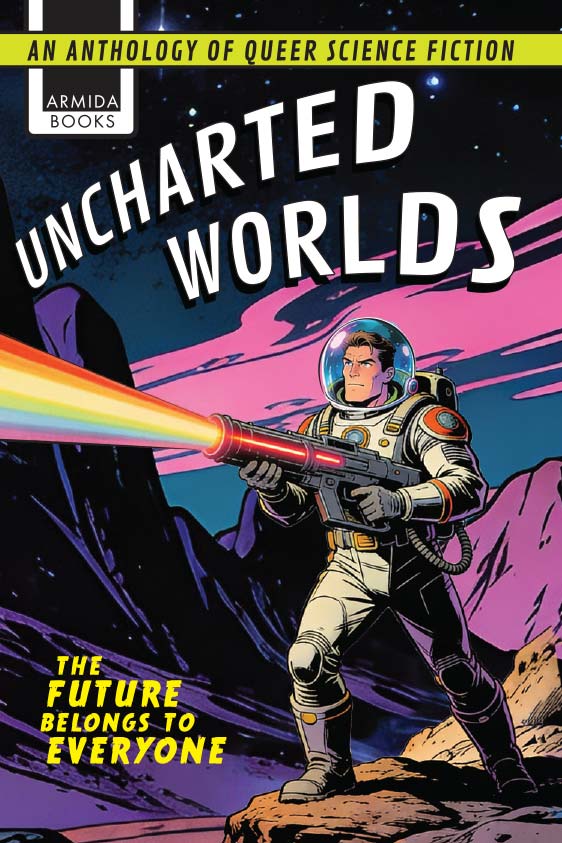
Uncharted Worlds brings together eleven queer science fiction stories exploring gender, sexuality, love, and identity across strange worlds and imagined futures. Eleven stories. Boundless possibilities.
Curator: Ünver Alibey
Authors: Dimitra Nikolaidou | Tuğrul Sultanzade | Christine Lucas | Chiara De Giorgi | Lara Reims | Cem Can | Ilse van der Hout | Victor Pseftakis | Rich Larson | Miska Ata | Lou Conradi
€14.00


What if identity had no boundaries?
Eleven stories. Eleven unique futures. One anthology of queer science fiction where gender, sexuality, love, and identity take forms most of us have never imagined.
From space opera and post-apocalyptic colonies to artificial realities, underground worlds, futuristic cities, and a Berlin club where minds connect and identities merge, Uncharted Worlds explores futures where nothing about who we are is predetermined.
Featuring eleven queer science fiction stories by authors from Greece, Italy, Belgium, Turkey, the Netherlands, Canada, Finland, Germany, and Cyprus, this anthology brings together diverse voices and distinct visions of the future.
Come for the strange worlds.
Stay for the people who inhabit them.
—
Curator: Ünver Alibey
Authors: Dimitra Nikolaidou (Cyprus) Tuğrul Sultanzade (Cyprus) Christine Lucas (Greece) Chiara De Giorgi (Italy) Lara Reims (Holland) Cem Can (Turkey) Ilse van der Hout (Holland) Victor Pseftakis (Greece) Rich Larson (Canada) Miska Ata (Finland) Lou Conradi (Germany)
THE FUTURE IS QUEER
by Ünver Alibey
Science fiction has traditionally been “straight,” with most stories assuming heterosexual characters and relationships. Samuel R. Delany has argued that the science fiction community has historically been dominated by white, male, and heterosexual voices.
Representation of diverse sexualities in science fiction has been inconsistent, sometimes lagging behind society and sometimes moving ahead. Nicola Griffith argues that LGBTQ+ readers often identify with outsider figures such as aliens, mutants, or characters with double lives. For example, the X-Men are often read as a metaphor for marginalized identities, including queer identity.
However, science fiction is also highly creative and flexible. It allows writers to imagine different societies and challenge ideas about heterosexuality and masculinity. Over time, especially through LGBTQ+ and feminist movements, queer identities have become more visible and accepted in science fiction. Works such as The Left Hand of Darkness by Ursula K. Le Guin explore gender as fluid rather than as a set of fixed categories.
In science fiction, writers imagine how things could be different rather than simply describing reality. This genre often makes readers feel “out of place” by presenting unfamiliar worlds, encouraging them to question ideas they normally take for granted. When gender and sexuality are changed in these worlds, readers are encouraged to rethink what is considered “normal.”
Science fiction often achieves this through advanced technology that alters sex or reproduction, or through gods, heroes, or other beings that exist outside human gender systems. For example, Star Trek: Deep Space Nine introduces the Trill, whose joined consciousnesses challenge fixed identity. In The Fifth Season by N. K. Jemisin, gender and identity are similarly flexible within non-fixed human categories.
These stories may also feature aliens with different systems of reproduction or social relationships. From a human perspective, some of these may resemble same-sex or bisexual relationships. For example, in Ancillary Justice by Ann Leckie, gender is not clearly marked in language or identity, and relationships are not based on binary gender roles.
Despite this freedom, queer characters are often still written in simple or stereotypical ways. Many stories continue to assume heterosexual relationships as the default. As a result, other sexualities are often shown indirectly or without challenging traditional gender roles. In older science fiction television and literature, queer-coded characters often appear without being explicitly identified as LGBTQ+.
Queer representation also varies by author. Stories with gay characters have often been written by women and are more likely to be aimed at female readers, while well-known male authors have historically been less likely to explore these themes. At the same time, authors like N. K. Jemisin and Martha Wells (The Murderbot Diaries) include more open and normalized queer or non-traditional identities.
However, writers such as Geoff Ryman argue that science fiction and gay-themed fiction are often treated as separate markets, with books marketed as one or the other but not both. David Seed also notes that some critics do not consider LGBTQ+-focused or socially engaged science fiction to be “real” science fiction. Works such as Dhalgren show how sexuality and identity have sometimes been marginalized within the genre.
Because of this, gay and lesbian science fiction has sometimes been treated as a separate category with its own publishers and awards, such as the Lambda Literary Awards, which include speculative fiction.
While representation has often been limited, stereotypical, or confined to niche markets, this is changing. Modern works such as The Space Between Worlds by Micaiah Johnson and Gideon the Ninth by Tamsyn Muir show how queer characters can exist naturally in mainstream speculative fiction. As more writers include LGBTQ+ identities, the genre becomes more inclusive and better reflects the diversity of real societies.
In this anthology, Uncharted Worlds, we have collected eleven science fiction stories with queer themes and characters from different countries. The authors in this anthology have created worlds where different forms of gender and sexuality can exist. These stories explore a wide range of identities and relationships, showing how science fiction can be used to imagine more diverse and inclusive societies.
The Help of Ga-Talos by Christine Lucas (Greece) follows a nun named Clio who encounters a mysterious mechanical-organic cat during a space journey. Together, they begin a rescue mission in a space opera setting.
The Dreamer’s Equation by Chiara De Giorgi (Italy) is set in a world where a scientist creates a simulated timeline and places her former partner inside it to test an ideal society she designed. As the partner begins to uncover contradictions in the world’s perfection, both must confront questions about control, reality, and free will.
One for the Team by Lara Reims (Belgium) takes place at a post-apocalyptic dome society called Olympus, where Katie is chosen to join a Mars colony while Patricia begins to question the system they live in and uncovers a hidden truth about their world.
Find and Retrieve by Cem Can (Turkey) follows an alien warrior and her partner sent to capture a human male to save their species. Their mission changes when they encounter a human mother protecting her child, forcing them to question their actions.
Under a Thousand Holographic Fish by Ilse van der Hout (The Netherlands) follows Vincent, a young man surviving in a harsh futuristic city through crime and illegal racing, while struggling with identity and morality.
The Song of Leviathan by Victor Pseftakis (Greece) is about loss and resistance to change, showing how characters come to accept inevitable transformation.
Carnivores by Rich Larson (Canada) follows a man working security at an exclusive restaurant who becomes drawn into a disturbing world that challenges his identity and morality.
Dash into Politics by Miska Ata (Finland) follows a space station engineer and adult content creator who reflects on power, fairness, and rebellion against rigid systems.
Nightlife by Lou Conradi (Germany) follows queer hybrid beings in a Berlin club whose mind-linking drag show blurs intimacy, violence, and collective identity. Their fragile connection breaks and reforms through care and conflict, hinting at a coming revolt.
With her story Blindness, Dimitra Nikolaidou (Cyprus) takes us to a dystopian society where individuality and beauty are strictly controlled. A young man named Plato ventures out after his release from prison and becomes entangled in a mysterious search connected to his grandmother’s past. As he navigates surveillance, fragmented memories, and hidden networks, he begins to question the truth behind the world he lives in.
Finally, Adele from Mozyniv by Tuğrul Sultanzade (Cyprus) tells the story of Arisi, a hardened man living in a brutal underground shelter on Mars, struggling with memories of poverty, prison, and a lost love that still haunts him. As he joins a tense mission with his crew, the harsh environment and his past continue to weigh heavily on his mind.
[ 1. FICTION / Science Fiction, 2. FICTION / Anthologies (multiple authors), 3. FICTION / Science Fiction / Queer fiction & Post-Apocalyptic, 4. Science Fiction / Genetic Engineering, 5. Science Fiction / Action & Adventure, 6. Science Fiction / Collections & Anthologies, 7. FICTION / LGBTQI/ Nature & the Environment]
| Επιμελητής/Curator | Ünver Alibey |
|---|---|
| Έτος/Year | 2026 |
| Έκδοση/Edition | 1st |
| Σελίδες/Pages | 228 |
| ISBN | 978-9925-646-51-7 |
| Γλώσσα/Language |

