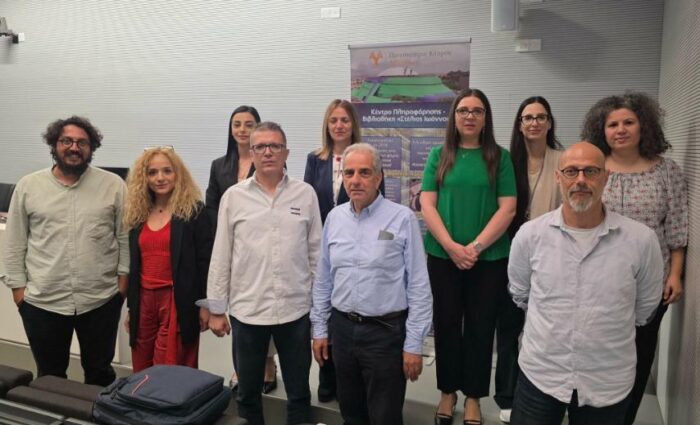
On May 28, 2026, I was invited by the University of Cyprus Library to participate in the event “Artificial Intelligence and Reading Culture: Challenges and Opportunities for Contemporary Writing.”
The following text is an adapted version of my presentation, “From Ink to Algorithm: The Future of Books in the Age of AI,” in which I offer my personal opinion on how AI is reshaping publishing production, what this means for authors, publishers, and readers, and why trust may become one of the most valuable currencies in the future of books.
My first encounter with printing goes back to the early 1980s.
I remember walking with my father into the printing house of his uncle, Minas, in old Nicosia. It was a noisy, heavy, almost industrial space, full of the smell of ink and paper. People moved through it with a kind of quiet ritual, in a place that felt much more like a machine workshop than anything I would have associated, at that age, with books.
I remember one man in particular, bent over a metal frame, effortlessly assembling lines of text from individual metal letters on wooden square blocks — only in reverse. To me, they were completely unintelligible and I was in awe of this man’s strange ability. Realizing my bewilderment, he took the time out of his work to explain it to me.
It was a centuries-old technology which, despite all the changes and developments around it, still preserved the same basic gesture: turning language into physical matter.
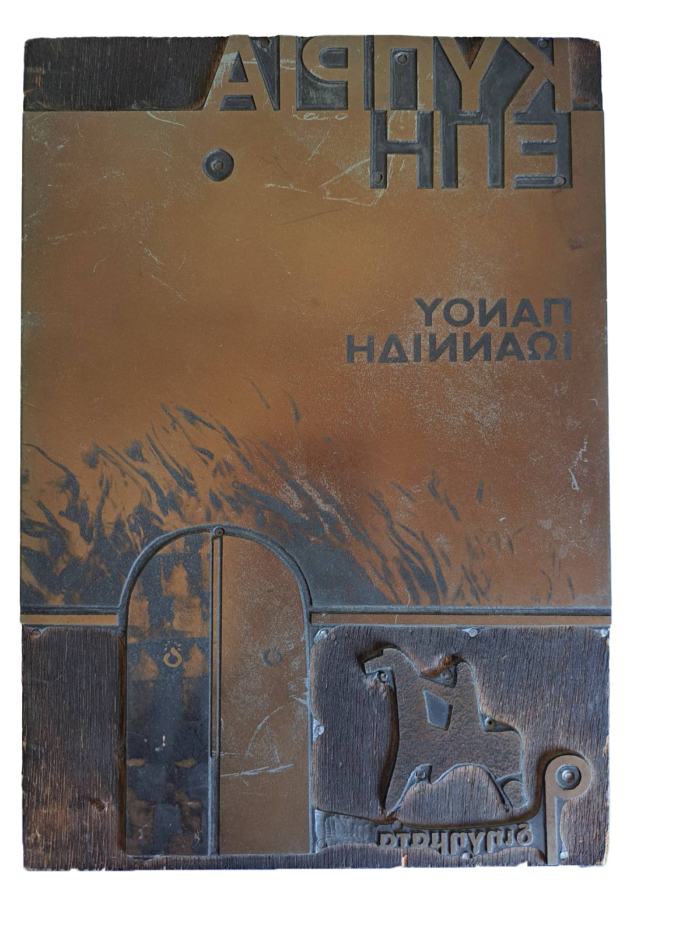
This is an old printing block from the cover of one of my father’s books. It is a little older than the one I saw being hand-crafted that afternoon, but it belongs to that world.
And within a single lifetime, we have moved from this world of metal, ink, wood, and paper to a digital environment in which a book can be designed, edited, translated, typeset, promoted, and distributed with the help of specialized platforms, software, and ΑΙ — almost at the touch of a button.
This is not simply a technological change.
It is a cultural shift.
It is a paradigm shift.
For centuries, between the idea and the finished book, there stood time, labor, material, technique, human work, and craftsmanship.
Today, that distance is almost no more…
And this, I believe, is where the real question begins.
Not whether AI can write but what it now means to create, publish, and read books in this new environment.
Good evening. My name is Haris Ioannides. I have been a publisher at Armida Books for 25 years. I am also co-founder of the Limassol International Book Fair and a founding member of the Cyprus Publishers Association.
Today’s speech is not about the technology itself. I will deliberately not focus on the individual tools currently available in the market. Not because they do not matter, but because there are too many, and in a state of constant flux! The tools that seem impressive today may, in a few months, have been replaced, absorbed into other systems, or simply surpassed.
I’d rather speak about how I see the future of books evolving in the age of AI, and about the new dynamics now emerging in publishing production.
What interests me most is the profound way in which the process has transformed: the way a book is produced, selected, edited, distributed — and ultimately trusted by readers.
For me, the heart of this discussion is not the name of the tool.
It is our attitude toward the possibility it offers us.
It is the personal and professional choice of how, when, why, and with what measure we use this new power.
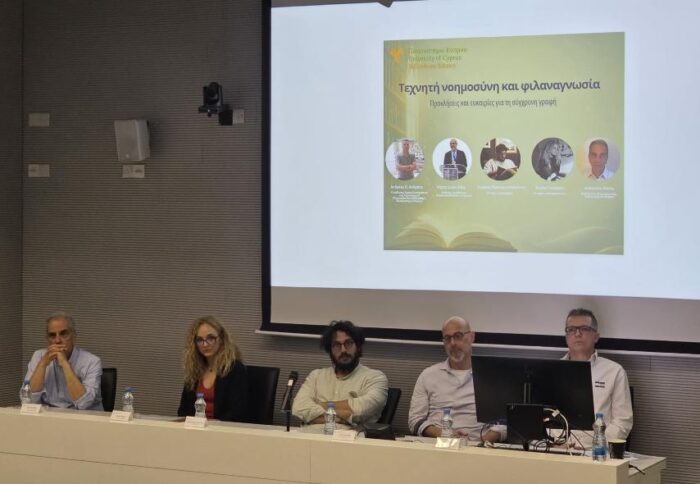
In recent years, I have participated in many international book fairs and publishing conferences around the world. And regardless of the continent, artificial intelligence and the future of reading and publishing are now center stage.
It is no longer a side discussion.
It is at the center of the room.
And this is not a conversation taking place only elsewhere.
In Limassol, through our very own Limassol International Book Fair Conference, we opened up these questions from the very beginning: technology, artificial intelligence, translation, copyright, and the future of publishing production.
We have hosted important international experts from the publishing industry, people who are at the forefront of these changes — and this year, this conversation will become even more intense.
Almost always, sooner or later, the discussion takes on an ethical dimension:
“good” versus “bad” AI, artificial intelligence as a threat to creativity, as something that cancels professions, as something that changes the landscape.
But as I have already mentioned, the discussion is ultimately not only about technology itself.
It is about us.
It is about our choices, and the way we decide to use these tools.
What we have before us is not simply a new tool.
It is an unprecedented expansion of human creative possibility.
For the first time, writers, publishers, and new creators have access to capabilities that, until only a few years ago, required entire teams of people, specialized knowledge, and significant infrastructure.
In this sense, artificial intelligence democratizes, to some extent, the creative and publishing landscape — an industry which, if I may use the term, was relatively elitist and closed to many, and is now becoming more open, more participatory, and more pluralistic.
This transition, of course, did not begin with AI.
From the mid-2000s, and especially after 2007, with the emergence of Kindle, Kindle Direct Publishing, and the spread of Print-on-Demand, the publishing landscape began to change radically.
For the first time, a creator could write, publish, and distribute a book independently on a global scale.
That paradigm shift, however, mainly affected the infrastructure of production and distribution.
We, as human creators, still remained at the center of the creative process.
Every writer still had to devote time, thought, energy, and imagination in order to write a work.
That work could then circulate before a vast global audience. And while there are brilliant exceptions, this new found access to distribution networks led to an overproduction of books without any sort of filter, without editing, and without meaningful evaluation. This is the new publishing landscape.
Artificial intelligence now changes something deeper.
It does not transform only distribution or production.
It transforms the creator’s relationship with the text itself — and even with the idea itself.
For the first time in history, a large part of the writing process can begin, be structured, or even be produced through a prompt.
And here I feel, we need to make an important distinction.
Writing a book requires more than simply being able to generate text. Language is not just a tool; it is an artistic medium through which writers express themselves. All the writers I know love language and choose it as the means through which they explore their inner lives and engage with the world around them.
Artificial intelligence can produce something that looks literary. But the production of style is one thing; the need to write is another. A text that is technically impressive is one thing; a text that emerges from experience, anxiety, memory, observation, and voice, is another.
So, in the coming years, we will see an unprecedented explosion of content: more books, more creators, more self-publishing, more hybrid content.
But at the same time, the real scarcity will no longer be production.
It will be attention. Credibility. Selection. Authentic voice.
If I had to summarize, in one sentence, how I see the future of publishing production, I would say this:
Publishing is moving from the production of content to the production of trust.
We’ve moved from asking, “Can we make it?” to asking, “Is it worth bringing to our readers?”
I must state that this is my personal assessment.
I do not claim that it is a universal answer for all publishers or all markets.
But it is the direction in which I am trying to lead Armida as well: a smaller, independent publishing house that cannot and does not want to compete in quantity, but can invest in selection, consistency, editing, and a relationship of trust with its readers.
The European publishing industry remains Europe’s largest cultural industry.
According to recent data from the Federation of European Publishers, the net turnover of European publishers approached 25 billion euros in 2024.
Against this seemingly enormous figure, major technology companies operate on an entirely different scale.
Amazon alone reported net sales of 638 billion dollars for 2024, while some of the major technology companies now operate, in terms of market capitalization, in the trillions.
And it is companies of this size that now shape the platforms, the infrastructure, the tools, and to a large extent, the conditions under which content circulates.
In Europe, we are trying to establish a framework: transparency, respect for copyright, rules.
I have also had the opportunity, through European industry discussions, to contribute in a small way to this conversation.
But books now circulate in a global environment, where the rules are not the same everywhere.
Production is becoming cheaper. Distribution is becoming more direct. Access is becoming more open. Content is becoming almost limitless.
And within this environment, the question for a smaller independent publisher is no longer simply whether they can produce a book.
The question is why anyone should trust them.
When I refer to “smaller independent publishers,” I do not simply mean publishers with a smaller turnover or a small number of employees. I am referring to publishers who build catalogs with a distinct personality, who take risks, who support new or less obvious voices, and do not make decisions based exclusively on the immediate bottom line.
Large publishing groups are necessary, and we should not demonize them. But by their nature and scale, they operate according to the logic of scale, efficiency, and financial result.
Smaller independent publishers, when they function well, do something different and complementary within their ecosystem: they operate as spaces of discovery, care, editing, and cultural plurality.
That is why the survival of smaller independent publishers is not simply a professional matter.
It is a matter of bibliodiversity — and bibliodiversity in any country is one of the clearest indicators of real democracy.
And here, a clarification is needed. This does not mean that authors who publish independently cannot produce important or high-quality work. Of course they can.
The distinction is simply that publishers operate within an ongoing editorial framework. Ideally, they make choices not only about individual titles, but about how those titles relate to a broader catalog, a set of values, and a long-term relationship with readers.
Here, I believe, lies the only meaningful space that remains — and perhaps the most important space that has ever existed — for smaller independent publishers: curation.
The systematic selection of good books and the active effort to improve texts, guided by literary quality, originality, coherence, language, aesthetics, and the quality of execution.
This triangular relationship — between author, publisher, and reader — is not new.
It always had to exist.
And healthy smaller independent publishers have always done this, and continue to do this: to build trust between the voice that writes, the publisher who selects and cares for the work, and the reader who gives time and attention.
Today, in an environment of overproduction, this relationship is more important than ever.
In a world where everything can be produced relatively cheaply and definitely quickly, smaller independent publishers will not survive because they produce more.
They will survive because they choose better.
And this depends on qualities that resist automation: a genuine love for books, passion, discernment, judgment, responsibility, and a consistent commitment to quality.
Here, then, lies the real challenge for me.
I cannot stand before artificial intelligence with absolute certainty.
It would be false to say that I have all the answers.
It would also be false to say that artificial intelligence has not already entered my own work and my own thinking.
But I have allowed it in my work environment in a collaborative way and not blindly.
The question, therefore, is not whether we will use it or not.
The question is how we will use it without giving up whats rightfully ours, as creators, publishers, readers, and as citizens.
For me, the line is not between use and non-use.
It is between conscious use and uncritical surrender.
And I will anticipate here a question that may arise from the audience: no, personally, I would not want to publish a work written entirely by AI.
This does not mean, however, that we can — or should — restrict authors who use AI tools to strengthen their writing, organize their thinking, test a phrase, work on a structure, or enter into dialogue with their own ideas.
We can, however, set limits, ask for transparency, and define what is not acceptable.
But neither do we currently have fully reliable ways to detect, beyond any doubt, whether and to what extent a text has been supported by such tools.
On the other hand, during a recent session of the Federation of European Publishers, the colleague representing the Netherlands presented results from consumer research according to which a very large percentage — approximately three out of four respondents — said that they would not be particularly concerned if a book had been written by a human being or by artificial intelligence.
I do not present this as a definitive truth, nor as something we should accept without critical reflection.
I mention it because it shows the environment in which we are operating.
And perhaps here lies another truth for smaller independent publishers who may agree with my position: we are not necessarily addressing the audience that treats books as just another form of disposable content, within the logic of continuous consumption — a kind of content binge.
We are rather addressing those readers who still care about origin, editing, voice, and the human responsibility behind a book.
Here I need to be clear: the perspective I am offering today concerns literature and creative writing as a human creation.
And we now need to say this, because we live in an age in which we can, at least conventionally, speak of non-human literature or non-human art.
There is, of course, the opposite side: the book as a product of artificial intelligence, the simulation of literature for an existing consumer market.
There, however, the question becomes more complex: it is not only who wrote it, but who selected it, who edited it, who takes responsibility for it, and by what criteria it reaches the reader.
My own position, as a publisher, as you will have understood by now, is on the side of creators.
On the side of literature as a conscious act of voice, experience, memory, observation, and inner necessity — on the side of the human voice that is not produced simply because production is possible, but because there is a need for something to be said.
We are in uncharted waters — trying to navigate in a storm.
No one can say with certainty what books, publishing, or reading will look like in ten or twenty years.
But we can consciously decide now how we will enter this transition: whether we will see it as an opportunity for greater access, greater plurality, and better curation, or whether we will allow it to become simply another mechanism for the unchecked production of content.
Because, in the end, the future of books will not be determined solely by the possibilities of technology.
It will be determined by the choices of the people who continue to write, publish, read, select, and care for the written word.
From ink to algorithm, then, the point is not to protect books from technology.
I am not even sure we can, no matter how many laws we pass.
The point is to protect what makes books uniquely human: the voice of the creator, the judgment of the publisher, and the relationship of trust with the reader.